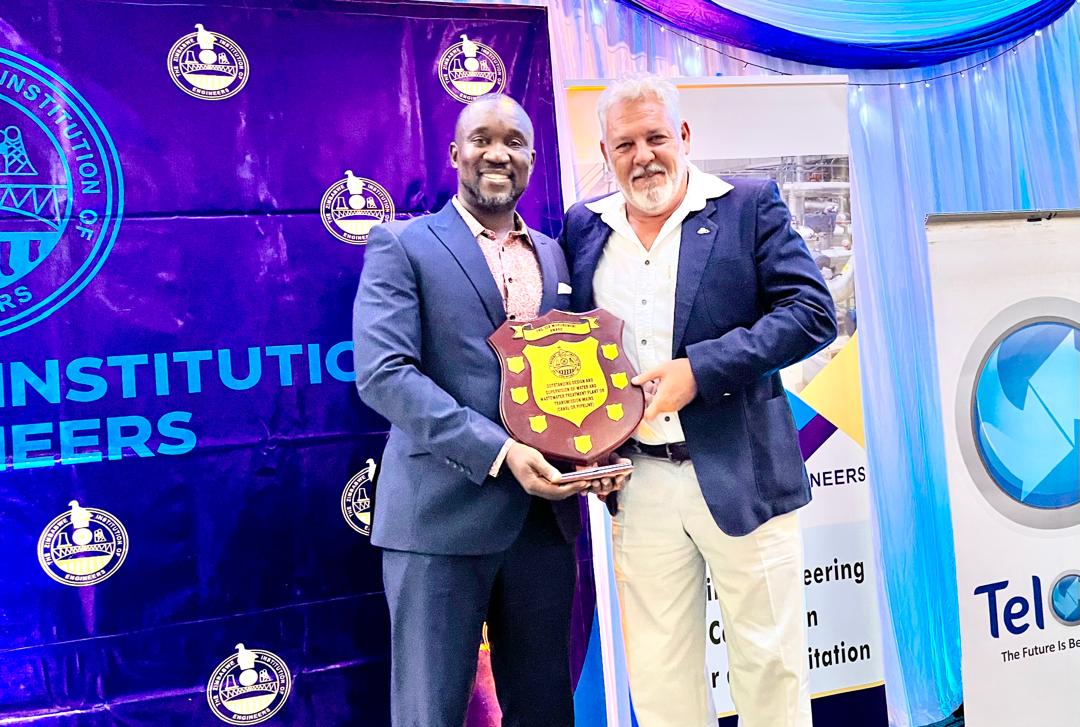
Padenga Agribusiness has been bestowed the coveted Engineer Zeb Murungweni Award by the Zimbabwe Institution of Engineers (ZIE) for the exceptional design and supervision of its state-of-the-art wastewater treatment plant at Kariba Crocodile Farm. Unveiled in March, 2025, the US$1.2 million facility, masterminded by Engineer Thami Mpala, Chief Executive Officer of Hydro Utilities, stands as a beacon of environmental innovation, redefining wastewater management in Zimbabwe’s crocodile farming industry.
Nestled on the shimmering shores of Lake Kariba, Padenga’s Kariba Crocodile Farm—the oldest of its three world-class operations—has long been a cornerstone of Zimbabwe’s agricultural landscape. Established in 1965, the farm produces 15,300 crocodile skins annually and serves as the company’s technical hub. The new wastewater treatment plant, a bold step toward environmental stewardship, ensures that wastewater from its operations no longer poses a threat to the lake’s delicate ecosystem. Instead, it emerges purified, meeting rigorous local and international standards, with extracted solids repurposed as nutrient-rich fertilizer.
The plant was designed by Engineer Thami Mpala, Chief Executive Officer of Hydro Utilities, who led the project with precision and vision. It employs cutting-edge technology to remove pollutants and suspended solids, transforming wastewater into a resource that is both environmentally safe and agriculturally valuable. “The water that we’re putting through the treatment plant is now coming out clean, having a positive impact on the environment,” said Charles Boddy, Padenga`s Operations Executive. “We’re extracting all the solids and suspended solids, which we can use as fertilizer. Instead of wastewater flowing directly into Lake Kariba, it now undergoes a formal treatment process.”

The ZIE’s recognition underscores the project’s technical excellence and its alignment with global sustainability goals. “We were nominated for the award, and we won,” Boddy declared with evident pride. “We’re extremely pleased to be acknowledged by the Zimbabwe Institution of Engineers. This honor is very motivating for us to continue our commitment to building and enhancing our wastewater treatment plants.” The award, named after a revered figure in Zimbabwean engineering, celebrates innovation that marries functionality with environmental responsibility—a ethos that Padenga embodies.
Padenga’s three farms—Kariba, Nyanyana, and Ume—are paragons of operational sophistication, each producing 15,300 skins annually and employing advanced technology to maintain a competitive edge. The Kariba farm, situated on land leased from the Parks and Wildlife Management Authority, has undergone significant modernization since its inception, with only a small section of original breeder pens remaining. Its infrastructure, bolstered by a shared abattoir and a robust research and development team staffed by veterinarians, reflects Padenga’s investment in excellence. The company’s commitment to data-driven management is evident in its use of penside computers and a dedicated team of analysts who generate real-time performance reports, ensuring accountability and continuous improvement through strict adherence to standard operating procedures.
The wastewater treatment plant is a testament to Padenga’s broader sustainability agenda. Chief Executive Officer Gary Sharp, speaking at the plant’s launch in March this year, emphasized its significance: “This project demonstrates our commitment to environmental responsibility and our dedication to protecting the natural resources of Zimbabwe.” The facility not only mitigates the environmental impact of crocodile farming but also enhances operational efficiency by repurposing waste, aligning with the principles of a circular economy.
The project’s success is rooted in meticulous planning and execution. Engineer Mpala’s expertise ensured that the plant’s design was both innovative and practical, capable of handling the unique challenges of treating wastewater from a crocodile farm. The facility’s ability to produce treated water that meets stringent standards safeguards Lake Kariba’s ecosystem, a critical resource for both wildlife and local communities. The extracted solids, rich in nutrients, offer a sustainable alternative to chemical fertilizers, further reducing the farm’s environmental footprint.
For Padenga, the award is more than a accolade—it is a call to action. “It gives us more motivation to continue with our mission for excellence,” Boddy affirmed. The company’s sustainability efforts extend beyond wastewater management. Nyanyana Crocodile Farm, contiguous to Kariba, hosts a 1.2MW grid-tied solar plant, with plans for expansion to achieve full renewable energy reliance for the northern farms. Ume Crocodile Farm, located 65km southeast, operates a 252kW solar plant to power daytime operations, underscoring Padenga’s commitment to reducing its carbon footprint.

The Engineer Zeb Murungweni Award places Padenga among Zimbabwe’s engineering elite, highlighting the transformative potential of strategic investments in sustainable infrastructure. As the company continues to refine its operations and expand its environmental initiatives, the Kariba wastewater treatment plant stands as a model for agribusinesses worldwide, proving that profitability and sustainability can coexist harmoniously.