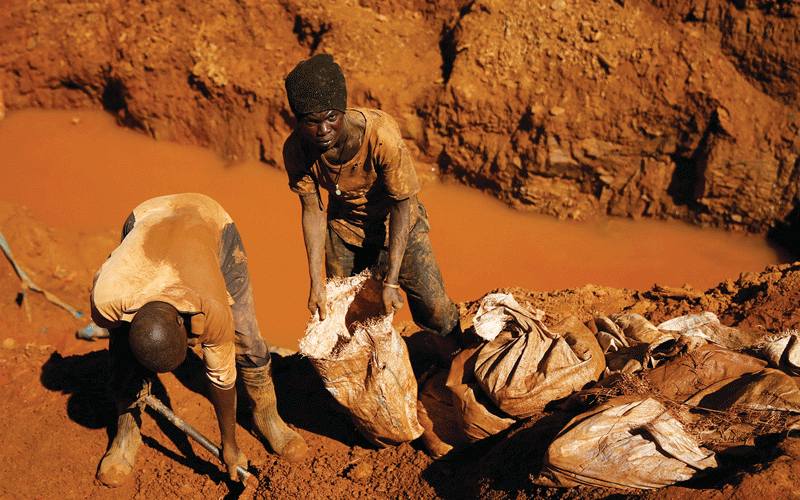
Zimbabwe’s rivers have become the latest front line in a widening battle between the state and an increasingly unruly artisanal mining sector, as police authorities warn that illegal alluvial mining now poses a direct threat to environmental security, public safety and the country’s long-term development ambitions.
Speaking to Great Dyke News on the sidelines of an engagement hoted by Silveira House in Mberengwa, Zvishavane District Officer Commanding Chief Superintendent Enoch Chishiri, said the force is intensifying enforcement against riverbed and alluvial mining, practices that the government has outlawed because of their destructive impact on waterways.
“No one in this country is permitted to carry out alluvial or riverbed mining,” Chishiri said. “The damage to the natural flow of our rivers, to water quality, and ultimately to human and animal life is simply too great.”
A constitutional mandate meets a mining boom
Zimbabwe’s mining sector—long seen as a pillar of economic recovery—has expanded rapidly in recent years, driven in large part by small-scale and artisanal miners seeking livelihoods amid persistent economic hardship. But that growth has been accompanied by rising fatalities, environmental degradation and criminal activity around mining sites, particularly in gold-rich districts such as Mberengwa.
Chishiri said the police response is rooted firmly in the Constitution, which assigns the ZRP responsibility for “detecting, investigating and preventing crime, maintaining law and order, safeguarding lives and property, and upholding the Constitution without fear or favour.”
“That mandate applies fully to the mining sector,” he said, adding that small-scale miners are a particular focus of current outreach and enforcement efforts.
Mercury, drugs and deadly accidents
Beyond the physical scarring of river systems, police are increasingly alarmed by the widespread use of mercury in gold processing, which often ends up spilled into rivers used by downstream communities.
“Mercury pollution is affecting humans and animals alike,” Chishiri warned, describing it as a silent but growing public health hazard.
He also pointed to drug and substance abuse at mining sites as a factor in preventable accidents. Since the start of the year, he said, at least three miners have died in work-related incidents—deaths he linked in part to impaired judgment and unsafe practices underground.
The ZRP, working alongside officials from the Mines and Minerals Office, has stepped up what Chishiri described as “concertised” safety, health and environmental education at mining operations, pairing awareness campaigns with the threat of enforcement where warnings are ignored.
Mining, security and Vision 2030
The crackdown is framed by the government as more than a law-and-order exercise. Chishiri said restoring discipline to the mining sector is essential to achieving Vision 2030, the national blueprint aimed at transforming Zimbabwe into an upper-middle-income economy by the end of the decade.
“A safe, secure and crime-free environment is what allows legitimate businesses to thrive,” he said. “Mining cannot contribute meaningfully to national development if it is characterised by lawlessness, environmental destruction and avoidable loss of life.”
Chishiri urged members of the public to report illegal mining activities and related crimes to local police commanders, stressing that community cooperation is critical if enforcement is to be effective.
As Zimbabwe continues to lean on its mineral wealth to drive growth, the message from law enforcement is unmistakable: the era of unchecked riverbed mining is over, and the costs of ignoring that reality—ecological, economic and human—are rising fast.