Table of Contents
By Edgar Gabarinocheka
As digital disinformation tightens its grip on global democracies, world leaders, technologists, and human rights defenders at the World Economic Forum’s Annual Meeting have converged around a shared dilemma: how to tackle falsehoods online without trampling on free expression.
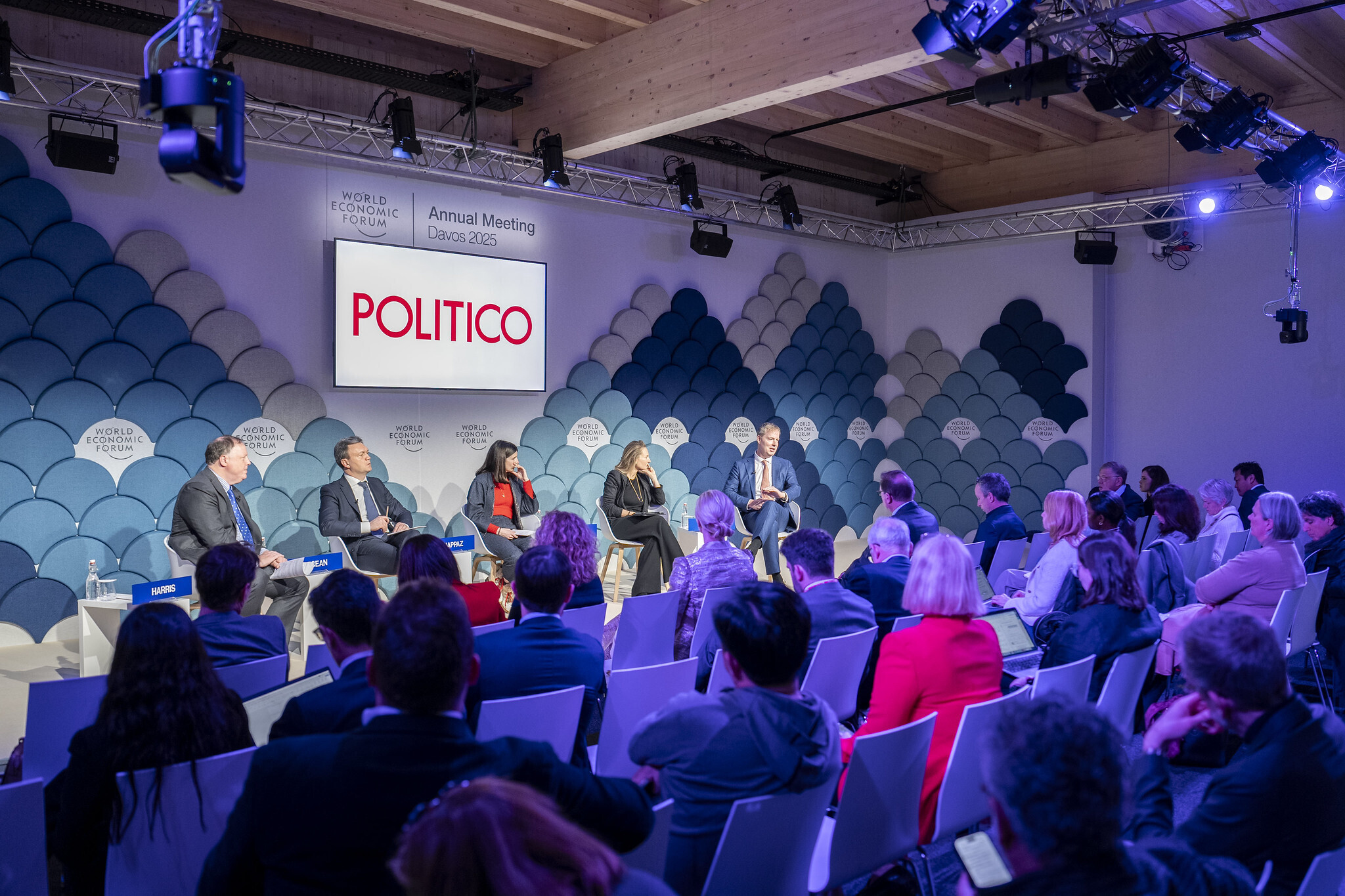
In two high-level sessions — Truth vs. Myth in Elections and To Moderate or Not to Moderate? — panellists unpacked what has emerged as the defining information crisis of the digital age. The discussion revealed deep tensions: how to protect democratic integrity, especially during elections, without inviting censorship; how to hold platforms accountable without empowering authoritarianism.
Disinformation: The Erosion of Trust
The Global Risks Report 2025 from the Forum paints a stark picture: disinformation ranks as the top short-term threat to global stability for the second consecutive year. Its fingerprints are now found on election outcomes, economic volatility, and civil unrest. In 2024, with half the world’s population voting, digital manipulation surged.
A striking case came from Moldova, where Prime Minister Dorin Recean recounted how foreign networks deployed AI-generated deepfakes to stir fear around EU integration. “They associate Europe with war,” he said. “And they prey on our children’s images to do it.” Moldova now spends 2.5% of its GDP fighting these information attacks.
Offline Rules, Online Realities
At the heart of the debate lies a demand: that digital platforms abide by the same standards as other public spaces. Jean-Noël Barrot, France’s Minister for Europe, emphasized, “What is illegal offline must be illegal online,” pointing to the EU’s Digital Services Act (DSA) as a cornerstone in setting global expectations on transparency and accountability.
Still, oversimplification is dangerous, warned Sasha Havlicek of the Institute for Strategic Dialogue. “Disinformation thrives in the shadows,” she noted. “Botnets, fake accounts, algorithmic exploitation — this is how the game is played. And the platforms are the playing field.”
A Crisis of Moderation — and of Ethics
With 1.6 billion pieces of content moderated in 2024 alone, content governance is no small feat. Tirana Hassan, former head of Human Rights Watch, stressed that moderation “must protect, not silence.” She warned of “the creeping risk of overregulation morphing into authoritarian control.”
UN Human Rights Chief Volker Türk added urgency: “These platforms often end up in crisis zones. Their misuse isn’t theoretical — it’s deadly.”
Meanwhile, tech companies face their own paradox. Generative AI, while spreading falsehoods at scale, could also help detect and stop it — if designed ethically. But current algorithms, experts say, are designed for attention, not accuracy.
“The attention economy doesn’t reward truth,” said Havlicek. “It rewards outrage, and that’s what gets amplified.”
Youth and the Normalization of Deception
Perhaps most disturbing is a growing generational shift. According to the 2025 Edelman Trust Barometer, 53% of 18–34-year-olds globally see disinformation — even malicious — as an acceptable form of activism. “They are adopting the very tactics we once condemned,” Latour of The Wall Street Journal said. “This signals a breakdown in civic trust.”
A Five-Point Path Forward
From the sessions, five key imperatives emerged:
- Radical Transparency – Platforms must open up their algorithms and data to independent researchers.
- Media Literacy – Equip citizens, especially youth, with tools to distinguish fact from fiction — without political bias.
- Co-Governance – Governments, tech firms, and civil society must co-create rules that protect both speech and safety.
- Ethical Tech Design – Platforms must integrate “safety by design” features to protect vulnerable users, especially minors.
- Balanced Moderation – Moderation must be rooted in international human rights, not political convenience.
The Fight for Truth: A Shared Responsibility
The panellists agreed that no single actor — neither government nor Silicon Valley — can win the battle alone. Journalists, educators, civil society, and citizens all have a role in upholding the fragile architecture of truth.
“Truth won’t moderate itself,” said Türk. “We need open spaces where evidence and science matter — not just shouting matches.”
In a polarized world flooded with curated content, disinformation isn’t just a technical problem. It’s a democratic one. And the cost of inaction, experts warn, may be trust itself.
“Rebuilding trust is not about consensus. It’s about creating space for diversity without division,” Hassan concluded.
Follow Edgar Gabarinocheka for more analysis on digital democracy and media ethics.
Edgar writes in his own capacity. His views are not those of Ya FM or Great Dyke News 24, which only provide a platform to encourage productive and constructive debate on national and global issues.