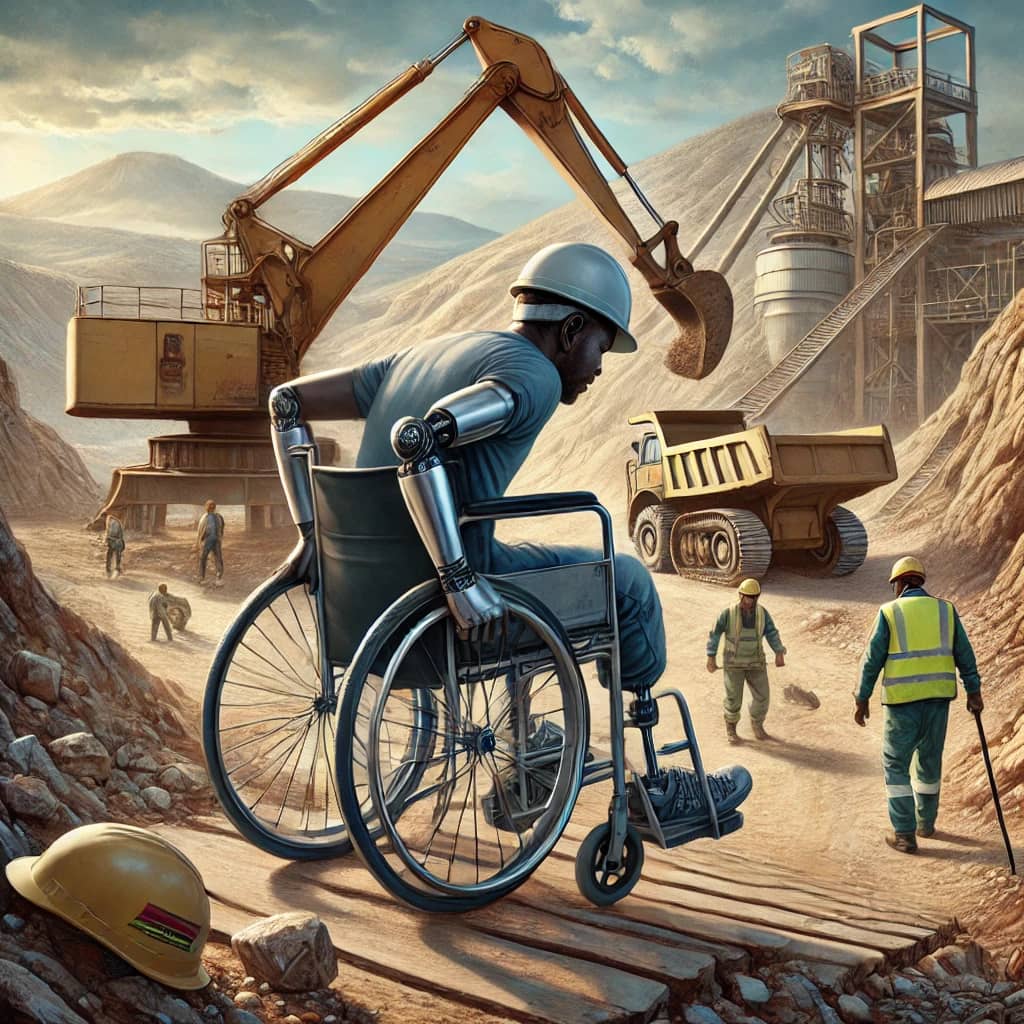
In Zimbabwe’s mineral-rich Great Dyke region, representatives of the mining community have raised concerns over the marginalization of People with Disabilities (PWDs) in the sector, despite their legal access to prospecting licenses.
Moses Marufu, the Mashonaland Provincial Secretary for Miners with Disabilities, told Great Dyke News that while PWDs face no overt discrimination when purchasing licenses, they are consistently overlooked for the support extended to other groups such as youths and women. This disparity, he argues, has entrenched their exclusion from an industry that is a cornerstone of Zimbabwe’s economy.
“There’s no barrier at the point of buying a prospecting license,” Marufu explained in an interview. “But when it comes to the support systems—training, funding, or equipment—PWDs are left out. Youths and women have programs tailored for them, yet we’re still on the sidelines.” His comments underscore a systemic gap in inclusivity within a sector projected to remain a key driver of Zimbabwe’s economic growth.
Zimbabwe’s mining industry is a powerhouse, contributing approximately 12% to the nation’s GDP and accounting for over 80% of its export earnings. In 2024, the sector generated significant revenue from gold, platinum group metals (PGMs), and lithium, though it faced challenges including power outages costing an estimated $500 million in potential earnings, according to the Chamber of Mines of Zimbabwe (COMZ).
Looking ahead to 2025, COMZ forecasts a mixed outlook: gold prices are expected to rise by 12%, boosting production, while PGMs and lithium may decline by 15%, with production costs rising by 8%. Despite these fluctuations, the sector’s capital expenditure is projected to exceed $600 million in 2025, signaling continued investment and growth potential.
Yet, for PWDs, access to this economic engine remains limited. Zimbabwe is home to an estimated 1.4 million people with disabilities—approximately 9% of its 15 million population—based on the 2022 National Census conducted by the Zimbabwe National Statistics Agency (ZIMSTAT). Many face barriers to employment and economic participation, with disability advocates arguing that the mining sector could offer a vital pathway to empowerment if structural inequities were addressed.
Marufu has called for legislative reforms to level the playing field.
“We need laws that recognize PWDs as a priority group in mining,” he urged. “The current Mines and Minerals Act doesn’t have provisions tailored for us. Without deliberate policies—grants, quotas, or accessible infrastructure—we’ll remain marginalized.” His plea aligns with broader advocacy efforts to amend the Act, which governs mining rights and operations but lacks specific measures for PWDs, unlike the targeted support seen for other demographics.
The issue is not new. In 2019, Marufu highlighted similar challenges, noting that inaccessible office infrastructure and communication barriers—such as a lack of sign language interpreters—further hinder PWDs’ participation. Five years on, progress remains sluggish, despite the sector’s formalization efforts and the government’s Vision 2030 goal of achieving an upper-middle-income economy, partly through mining-led growth.
Zimbabwe’s mining policies have evolved in recent years, with moves like the 2024 suspension of Exclusive Prospective Orders (EPOs) in favor of Exclusive Exploration Licences (EELs) aimed at curbing speculative land grabs. However, these reforms have yet to address the unique needs of PWDs. With the Great Dyke hosting vast reserves of PGMs and chromium—estimated at 2.8 billion tonnes and 10 billion tonnes, respectively—the stakes are high for inclusive participation.