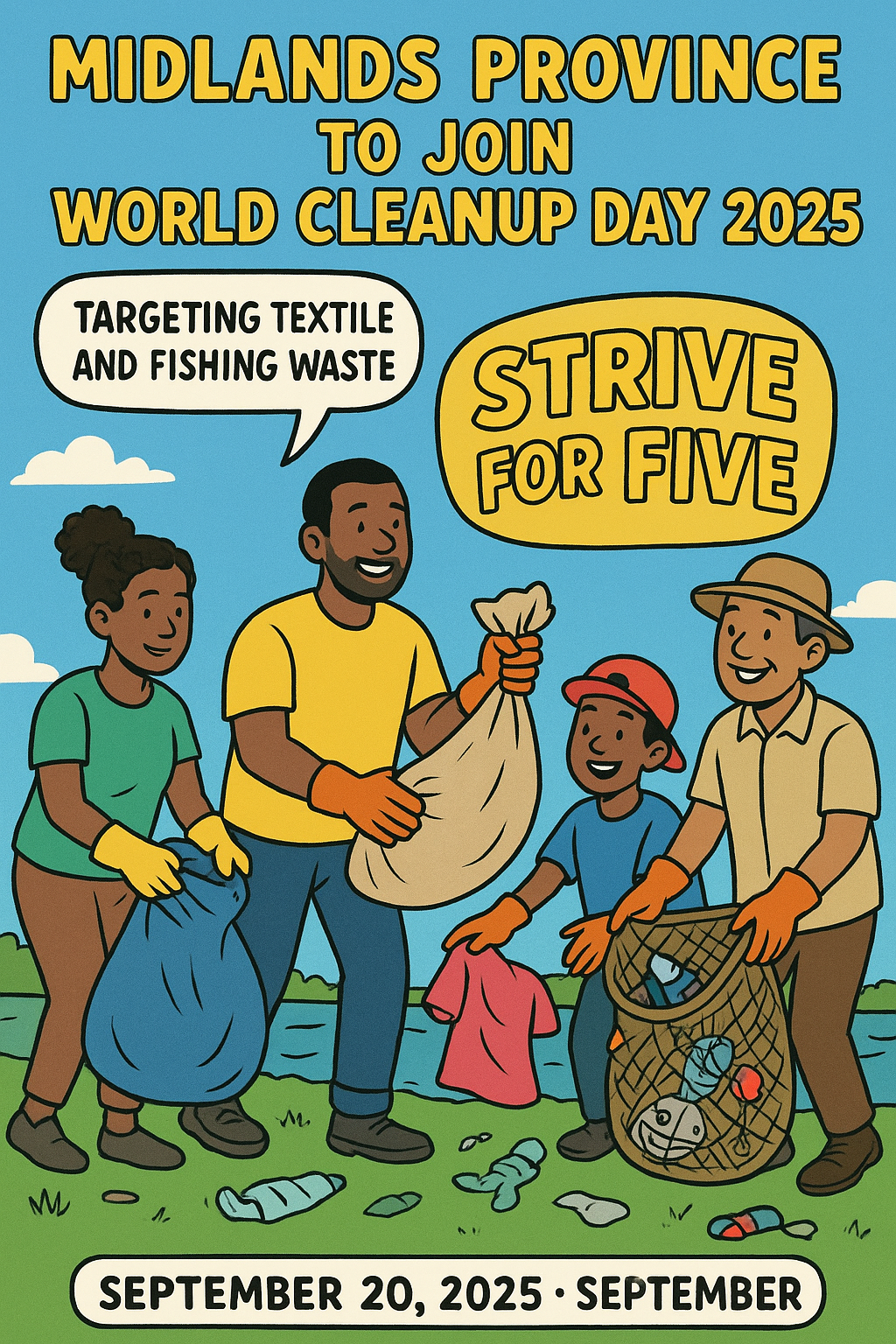
Midlands Province will participate in World Cleanup Day on September 20, 2025, focusing on textile and fishing waste under the theme “Strive for Five.” The Environmental Management Agency (EMA)`s Midlands Provincial Environmental Education and Publicity Officer Oswald Ndlovu, urged residents to conduct cleanups in their communities to mark the occasion.
World Cleanup Day, an annual global social action program aimed at combating the solid waste crisis including marine debris, originated in Estonia in 2008 when 50,000 volunteers cleaned the country in just five hours, inspiring the international movement “Let’s Do It! World.” The first global observance took place in 2018, uniting volunteers across 150 countries and evolving into the largest civic movement in history, with over 114 million participants in 211 countries and territories to date. Recognized by the United Nations General Assembly in December 2023 via resolution 78/122, it was officially proclaimed as an International Day starting in 2024 to promote sustainable waste management and collective responsibility.
This year’s “Strive for Five” theme seeks to mobilize 5% of the world’s population—approximately 400 million people—in cleanup and awareness efforts, emphasizing mass participation to address the global mismanaged waste crisis. The campaign highlights textile and fishing waste as key priorities, with events spanning every time zone from beaches to forests.
Globally, the textile industry generates 92 million tonnes of waste annually, equivalent to one garbage truck per second, while production has doubled since 2000 and garment use duration has dropped by 36%. Only 8% of textile fibers are recycled, contributing 11% of plastic waste and up to 10% of global carbon emissions. Fishing waste, particularly “ghost gear” like abandoned nets and lines, accounts for 10% of marine litter, with 500,000 to 1 million tonnes entering oceans yearly—nearly 2% of all gear lost annually—and entangling up to 66% of marine species. These issues exacerbate the broader waste epidemic, with over 2.12 billion tons generated worldwide each year.
This year’s campaign emphasizes reducing, reusing, and recycling textile materials to promote a circular economy. Ndlovu called on the textile industry to shift toward sustainable production practices. “We encourage the public to collaborate and clean up their areas to observe World Cleanup Day,” he said.
The initiative aims to address the environmental impact of textile and fishing waste, which contributes to pollution in the province’s rivers and landscapes.