By Edgar Gabarinocheka
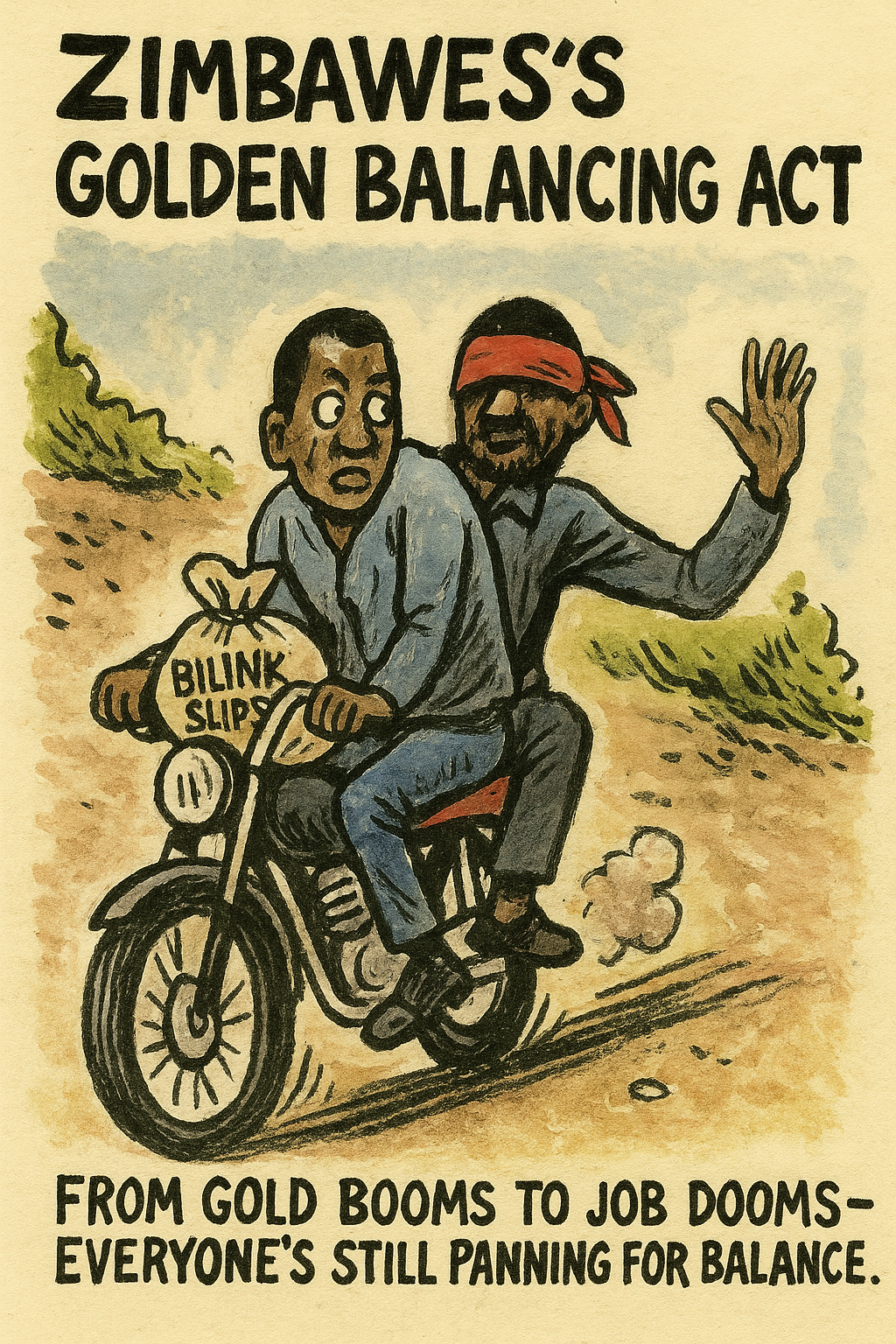
I sometimes think Zimbabwe’s economy is like a motorbike carrying two people up a dust road — one waving at investors, the other praying the fuel lasts to the next turn. You don’t need a finance degree to see the wobble. A bit of gold glitters here, a shaft floods there, and someone still insists we’re on the highway to Vision 2030.
This past week, the headlines were a study in contrasts. On one page, Caledonia Mining celebrates a 467% profit rise, with record gold prices shining bright. On another, the ZRP releases the names of seven artisanal miners who drowned in Silobela after a shaft flooded. I’ve taught economics long enough to know what that means: the profits are tallied in the city, but the costs are buried in the countryside.
Yes, the numbers dazzle. Revenue up 52%, output steady, optimism overflowing. But for every ounce of gold extracted, there’s a story of mud, sweat, and danger. It is a cruel equation — where safety gear costs more than life itself. When I read that the victims’ bodies were retrieved days later, I wondered how many of their families have ever held a single gram of the gold that took their lives.
Meanwhile, across town, Dutch investors were shaking hands at State House, pledging millions for expansion in Shamva. “Zimbabwe is open for business,” they were told. I don’t doubt their sincerity. Foreign capital is like rain — it must fall somewhere. But as any farmer will tell you, not every storm brings harvest. The real challenge is ensuring the rain doesn’t flood the field.
I admire that Canterbury Mine has built schools and houses for teachers. It’s good to see a company think beyond the pit. Yet we must be careful that we don’t end up applauding the same investors for fixing problems that governance should have prevented. Corporate philanthropy is not a substitute for policy.
Then there’s the lithium story — once our poster child of the “new economy,” now reduced to abandoned pits and rusting picks. When prices fell, so did enthusiasm. Artisanal miners, who had rushed to peg claims and dream of Teslas, quietly packed up and went home. It reminded me of the students who used to chase every business fad — poultry one year, mushrooms the next — but never learned the principle of sustainability.
The lesson is simple: boom-and-bust cycles are not development. Real growth comes from planning, not panic digging.
And while we’re at it, spare a thought for the AI revolution sweeping away jobs in the United States. Over a million layoffs, they say, as machines outthink humans. Some might see it as a distant problem, but we should be asking — will we wait until AI replaces us, or can we use it to improve mine safety, detect corruption, and manage logistics better? Technology isn’t the enemy; complacency is.
Then I read that policy analyst Mukasiri Sibanda warned against monopolies in the critical minerals sector — a voice of reason in the noise of dealmaking. He’s right. If we place all our bets on one foreign power or one investor, we risk trading dependency for another form of control. It’s like letting one passenger steer while you hold the fuel tank. Eventually, someone gets burned.
Yet not all is gloom. The Nedbank Tour de Great Dyke rolled out again last week, a colorful reminder that progress also means endurance. Cyclists pedaling for wellness and charity might seem trivial beside gold prices and profit charts, but perhaps they carry the real metaphor: steady motion, teamwork, and balance.
Zimbabwe doesn’t need more miracles. It needs rhythm — a consistent cadence between profit and protection, between investment and inclusion. The road ahead is steep, yes, but no hill lasts forever.
So as I sip my morning tea and read about profits, floods, and AI pink slips, I return to a lesson I gave my students many years ago: economic progress is not how fast you go, but how well you stay upright.
We’ve seen the gold glitter and the lithium dust. Maybe it’s time to fix the brakes before the next curve.
Disclaimer – The views expressed in this article are those of the author, Edgar Gabarinocheka, and do not necessarily reflect the official position of Ya FM or Great Dyke News 24. The content is intended for informational and opinion purposes only. Readers are encouraged to verify facts independently and exercise their own judgment.