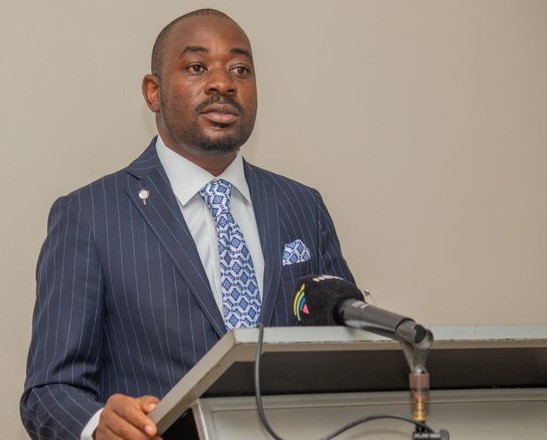
Nelson Chamisa’s return to frontline politics has the cadence of a resurrection—and the irony of timing is hard to miss. Re-emerging after a dramatic withdrawal from leadership, the opposition figure has launched his comeback by declaring Zimbabwe’s long-ruling ZANU PF “collapsed,” even as the party remains firmly in control of the state.
Addressing supporters, Chamisa offered one of his most blistering critiques yet of the governing party, portraying it as internally hollowed out and ideologically exhausted. “They are now into smithereens… into debris,” he said, arguing that ZANU PF no longer functions as a coherent political organisation but survives only in form, not in spirit.
To Chamisa, defections by senior figures—including former Central Committee member Geza—symbolise a party that has lost its moral and political centre. Those still inside, he claimed, are present “in body, but their spirit is gone,” increasingly aligned with public frustration rather than party orthodoxy.
Yet the force of Chamisa’s rhetoric collides with a stubborn political reality. ZANU PF continues to dominate Zimbabwe’s institutions, holding a parliamentary majority and retaining control of the executive and security apparatus. Its leaders dismiss Chamisa’s assessment as political theatre, arguing that the ruling party remains disciplined, organised and electorally formidable.
That contrast—the opposition leader’s declaration of collapse versus the ruling party’s enduring grip on power—underscores the paradox at the heart of Chamisa’s comeback. Having resigned as leader of the Citizens Coalition for Change (CCC) in January 2024 amid internal turmoil and legal disputes, Chamisa now presents himself as a solution to a leadership vacuum he once stepped away from.
“Yes, I left the dance floor,” he told supporters, “but there was no party to dance.” He cast his exit as an act of political honesty, insisting that ZANU PF could not “dance alone,” nor sustain momentum even with what he described as carefully constructed internal alliances.
Political analysts say the imagery is powerful—but also revealing. While Chamisa depicts the ruling party as exhausted, critics note that Zimbabwe’s opposition remains fragmented, struggling to convert popular discontent into durable organisation. In that sense, Chamisa’s political resurrection is as much about rebuilding credibility and structure as it is about confronting ZANU PF.
Still, his return is likely to re-energise a base weary of disunity and searching for direction. By framing his comeback as a moral obligation—“a duty to lead… executed with grace”—Chamisa is betting that symbolism, timing and renewed clarity of purpose can reignite momentum.
Whether this resurrection marks a genuine turning point or another cycle of opposition rhetoric will depend less on declarations of collapse and more on the hard work of mobilisation, unity and strategic discipline—areas where Zimbabwe’s opposition, not the ruling party, has most visibly faltered in recent years.