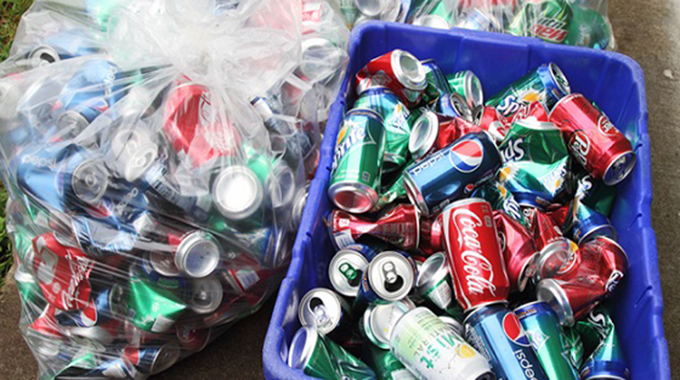
KWEKWE, Zimbabwe – In the bustling high-density suburb of Mbizo, Kwekwe, a group of dedicated recyclers is transforming discarded cans and plastics into a lifeline for their families, while also tackling the growing problem of littering in Zimbabwe. These informal workers, operating with minimal resources, are earning a living by collecting and recycling materials, contributing to both economic empowerment and environmental sustainability. However, they face significant challenges, including a lack of designated workspaces and equipment, prompting calls for government intervention to bolster the recycling industry.
Tsitsi Gavi, a recycler in Mbizo, recently shared her story, highlighting the dual impact of her work. “Recycling has really helped us,” Gavi said. “It’s not just about cleaning the environment; it’s about putting food on the table for our families.” She explained that selling collected aluminum cans and plastic bottles to recycling companies provides a crucial income stream in a country where unemployment hovers around 20%, according to Zimbabwe’s 2021 labor survey. Yet, the lack of local recycling facilities forces her and others to travel to Harare, a costly and time-consuming journey. “We have to store cans and bottles at our homes sometimes, which isn’t hygienic for us or our neighbors,” Gavi added, appealing for government support to provide dedicated workspaces and equipment to grow the industry and curb littering.
Zimbabwe generates approximately 1.9 million tonnes of municipal solid waste annually, with only 16% recycled, according to 2016 data from the Environmental Management Agency (EMA). In Mbizo, recyclers like Gavi are part of an informal sector that has quadrupled in recent years, now handling 15% of the country’s plastic waste, as reported by EMA in 2023. This mirrors a broader trend across Zimbabwe, where community-based recycling initiatives are gaining traction, as seen in programs like the Chitungwiza Recycling Program and the Bulawayo Composting Project. These efforts align with the national clean-up campaign, launched in 2018, which promotes waste segregation and recycling under the theme “Zero Tolerance to Litter – My Environment.”
Despite their contributions, recyclers in Mbizo face significant hurdles. The absence of local recycling facilities means they must transport materials to Harare, increasing costs and reducing profits. Storing waste at home poses health risks, a concern echoed in studies from Kwekwe showing that improper waste handling, including medical waste, can lead to land pollution and disease transmission. Moreover, the lack of municipal bins, as noted in a 2024 study of Kwekwe’s Amaveni suburb, exacerbates littering, with 100% of surveyed residents reporting that the Kwekwe City Council no longer provides bins due to financial constraints.
Gavi’s plea for government support reflects a broader need for infrastructure to formalize and scale the recycling industry. “If the government could recognize our work and provide spaces or machines, we could do more to keep Kwekwe clean and grow this business,” she said. The Zimbabwe Integrated Solid Waste Management Plan envisions a sustainable waste system, but implementation lags due to limited funding and infrastructure.
Globally, the challenges faced by Mbizo’s recyclers are not unique. In developing countries, informal recyclers are critical to waste management, handling up to 60% of recycled materials in some regions, according to the World Bank. In India, waste pickers in cities like Delhi collect and sort recyclables under similar conditions, often without formal support, yet contribute significantly to reducing landfill waste. In contrast, countries like Germany have robust recycling systems, achieving a 67% recycling rate for municipal waste through government-funded infrastructure and mandatory waste segregation. South Africa, a regional neighbor, recycles only 33% of its 50 million tonnes of annual waste, but initiatives like WasteAid are formalizing the sector by providing training and equipment to recyclers.
Zimbabwe could draw inspiration from such models. For instance, the Gambia’s Njau Recycling and Income Generation Group, founded by Isatou Ceesay, has turned waste collection into a community-driven enterprise, reducing plastic pollution and creating jobs with minimal government support. Similarly, Zambia’s partnership with the United Nations Environment Programme promotes circular economy principles, offering a potential roadmap for Zimbabwe to integrate waste-to-energy technologies and formalize recycling.
The global waste management market, valued at US$400 billion, underscores the economic potential of recycling. In Zimbabwe, a 2022 study in Mutare estimated that low-income suburbs lose up to US$45,000 monthly in potential income from unrecycled materials, highlighting the economic opportunity for Mbizo’s recyclers if supported. Programs like BIN-it Zimbabwe, which promotes source separation, could be expanded to Kwekwe to enhance recyclers’ efficiency and reduce health risks.
As Mbizo’s recyclers continue their vital work, their call for government assistance resonates as a critical step toward a cleaner, more sustainable Zimbabwe. By investing in workspaces, equipment, and local recycling facilities, the government could empower these unsung heroes, reduce littering, and tap into the global circular economy, turning trash into treasure for both the environment and the economy.