Zvishavane, Zimbabwe — On a sunlit afternoon at Gresham Primary School Grounds, hundreds of schoolgirls sat among miners, engineers and policymakers as a message echoed across the 2026 Schools and Innovation Fair: the future of Zimbabwe’s mining industry is not only underground — it is increasingly female.
Standing before learners, Ruvimbo Kadenhe, secretary general of the Women in Gemstones Association of Zimbabwe (WIGAZ), challenged long-held assumptions about who belongs in one of the country’s most critical economic sectors.
“Mining is a business,” she said, her voice carrying across the exhibition tents. “There are many careers in mining that you can pursue — geologists, engineers, environmental specialists, entrepreneurs. You belong in this space too.”
Her remarks come at a time when Zimbabwe is seeking to broaden participation in mining, a sector that anchors export earnings but has historically been dominated by men and large-scale operators. Increasingly, policymakers and industry groups are looking to women and young people as an untapped source of growth.
Kadenhe framed mining not as a narrow, physically demanding occupation, but as a diverse, technology-driven ecosystem with roles spanning science, business and creativity. She pointed to gemstones as one example, where value addition — from cutting and polishing to jewelry design — offers pathways for entrepreneurs beyond extraction.
“The industry is evolving,” she said. “It is no longer just about digging. It is about innovation, knowledge and creating value.”
That shift is already underway. Across Zimbabwe, small-scale miners — many of them women — are entering the sector with limited resources, learning technical skills and building enterprises that sustain families and employ others. Kadenhe said she has witnessed these transformations firsthand.
“That is the power of opportunity,” she told the audience. “Women come in with very little, and through knowledge and persistence, they build something sustainable.”
Yet the pathway remains uneven. Access to financing, equipment and technical training continues to constrain new entrants, particularly women. These structural barriers, Kadenhe acknowledged, cannot be ignored.
“Success does not come easily,” she said. “But exposure and education can change the trajectory.”
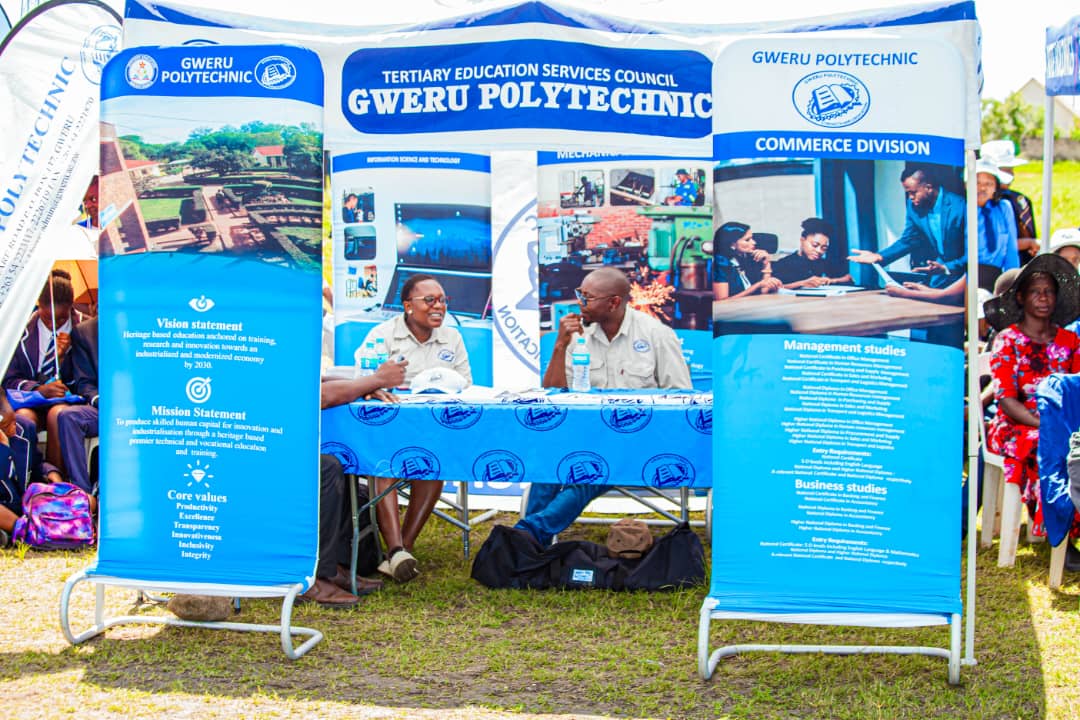
The fair itself — a convergence of schools, mining companies, financial institutions and government officials — reflects a broader push to align education with Zimbabwe’s economic priorities. As the country looks to move up the value chain in minerals such as gold, lithium and gemstones, the demand for skilled labor is rising.
Kadenhe emphasized that the industry’s future will depend not only on technical expertise, but also on a new generation of problem-solvers capable of navigating a rapidly changing landscape.
“The future of mining will need smart thinkers, innovators,” she said. “People who can see opportunities where others see challenges.”
Her appeal carried a deeper social dimension. Economic participation by women, she argued, extends beyond individual success — it reshapes households and communities.
“When young women are empowered economically, families become more stable. Children stay in school. Communities develop,” she said, noting that women’s earnings are often reinvested locally.
For many of the students gathered in Zvishavane — a town at the heart of Zimbabwe’s mineral-rich Great Dyke — the message landed close to home. Mining is not an abstract concept here; it is a daily presence, shaping livelihoods and local economies.
But Kadenhe urged them to see beyond what they already know.
“Do not limit your dreams to what you have seen,” she said. “Expand them to what is possible.”
As Zimbabwe pushes to modernize its mining sector and expand inclusion, the challenge will be turning such messages into measurable change — ensuring that the next generation of geologists, engineers and entrepreneurs includes the girls who, on this day, were told they belong.