Table of Contents
Zimbabwe’s trade surplus narrowed sharply in February, underscoring the fragile balance between export-led earnings and a rising import bill that continues to reflect deep structural dependencies in the economy.
Data released by the Zimbabwe National Statistics Agency (ZimStat) shows the country recorded a goods trade surplus of $46.4 million in February 2026, down 57.7% from the $109.9 million surplus posted in January.
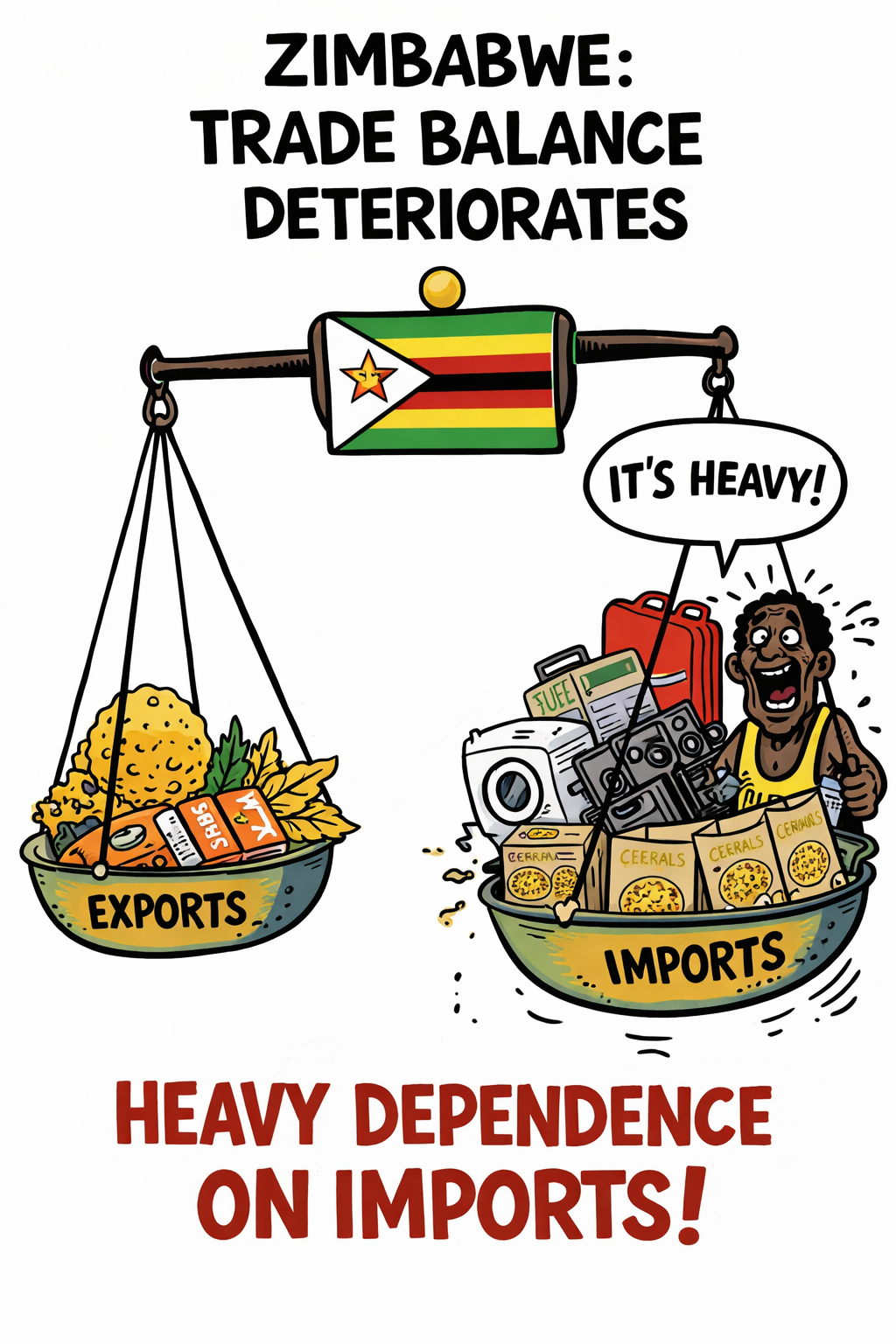
The decline came despite modest growth in exports, as imports surged at a faster pace—highlighting the persistent tension between Zimbabwe’s resource-driven export base and its reliance on foreign inputs for production and consumption.
Export Growth Fails to Keep Pace
Zimbabwe’s exports rose to $1.01 billion in February, a 4.1% increase from the previous month, driven largely by mineral and agricultural commodities.
Gold remained the dominant export, accounting for 45.7% of total shipments, followed by tobacco at 27.5%, with other mineral substances contributing a further 9%, according to ZimStat.
The composition of exports reflects a familiar pattern: a heavy reliance on primary commodities with limited value addition. While this structure allows Zimbabwe to capitalize on favorable global prices—particularly for gold—it also leaves earnings vulnerable to price volatility and external demand shocks.
Geographically, exports remain highly concentrated. The United Arab Emirates, China, and South Africa together absorbed nearly 90% of Zimbabwe’s export value in February, with the UAE alone accounting for $468.4 million.
Such concentration, analysts say, creates both opportunity and risk. While strong demand from these markets supports foreign currency inflows, it also exposes Zimbabwe to geopolitical and economic shifts in a narrow set of trading partners.
Import Bill Accelerates
If exports showed steady—if unspectacular—growth, imports told a more urgent story.
Zimbabwe’s import bill climbed to $963.1 million, a 12% increase from January, driven by demand for fuel, machinery, and foodstuffs.
Mineral fuels and oils accounted for 18.6% of imports, followed by machinery (14.9%), electrical equipment (9.1%), and cereals (7.3%).
The import profile underscores the country’s dependence on external supplies for energy, industrial capacity, and food security—three pillars critical to economic stability.
South Africa remained Zimbabwe’s largest source of imports at $338.9 million, followed by China ($215.3 million) and smaller contributions from Bahrain and the Bahamas.
Together, these four countries accounted for roughly 70% of total imports, reinforcing the asymmetric nature of Zimbabwe’s trade relationships: concentrated exports on one side, diversified but essential imports on the other.
Regional Trade: Opportunity and Constraint
Within the Southern African Development Community (SADC), Zimbabwe’s export basket shifts slightly toward industrial minerals and intermediate goods.
Nickel ores and concentrates accounted for 28.3% of exports to the region, followed by coke and semi-coke (11.7%) and industrial diamonds (10.1%).
Meanwhile, imports from SADC were dominated by cereals, machinery, and fuel—collectively making up about 38% of the $435.2 million import bill from the region.
This dynamic highlights a regional trade imbalance: Zimbabwe exports raw or semi-processed minerals while importing higher-value goods and essential commodities.
Under the African Continental Free Trade Area (AfCFTA), a similar pattern emerges. Exports are led by nickel ores, coal products, and iron and steel, while imports continue to be driven by machinery, cereals, and fuels.
Limited Diversification Beyond Commodities
Exports to more developed markets show signs of diversification but remain narrow in scope.
To the European Union, Zimbabwe’s exports were dominated by tobacco (38.2%) and industrial diamonds (28.1%), with ferro-chromium and granite making up much of the remainder.
In COMESA markets, iron and steel products, coal derivatives, and tobacco featured prominently, again pointing to a reliance on low- to mid-value goods.
Economists argue that without significant industrial upgrading, Zimbabwe risks remaining locked into a commodity-export model that limits long-term growth and job creation.
Structural Questions Resurface
The February trade data reinforces a familiar narrative: Zimbabwe can generate foreign currency through exports, but sustaining a strong surplus remains elusive as import demand rises.
The sharp drop in the trade surplus—despite higher exports—suggests that incremental gains in commodity earnings are being outpaced by structural import needs.
Energy imports, in particular, remain a critical pressure point, while the continued reliance on imported machinery signals limited domestic manufacturing capacity.
At the same time, food imports—especially cereals—highlight vulnerabilities in agricultural output, even as tobacco remains a leading export.
The Road Ahead
For policymakers, the data presents a dual challenge: boosting export value while containing import dependence.
Efforts to promote beneficiation in mining, expand industrial capacity, and strengthen domestic agriculture could help rebalance the trade equation. But such reforms require sustained investment, policy consistency, and improved access to capital—issues that remain central to Zimbabwe’s economic debate.
In the near term, however, the trajectory is clear. Zimbabwe’s trade position, while still positive, is becoming increasingly sensitive to import pressures—a reminder that surplus alone does not equate to structural strength.
As February’s figures show, the margin for error is narrowing.