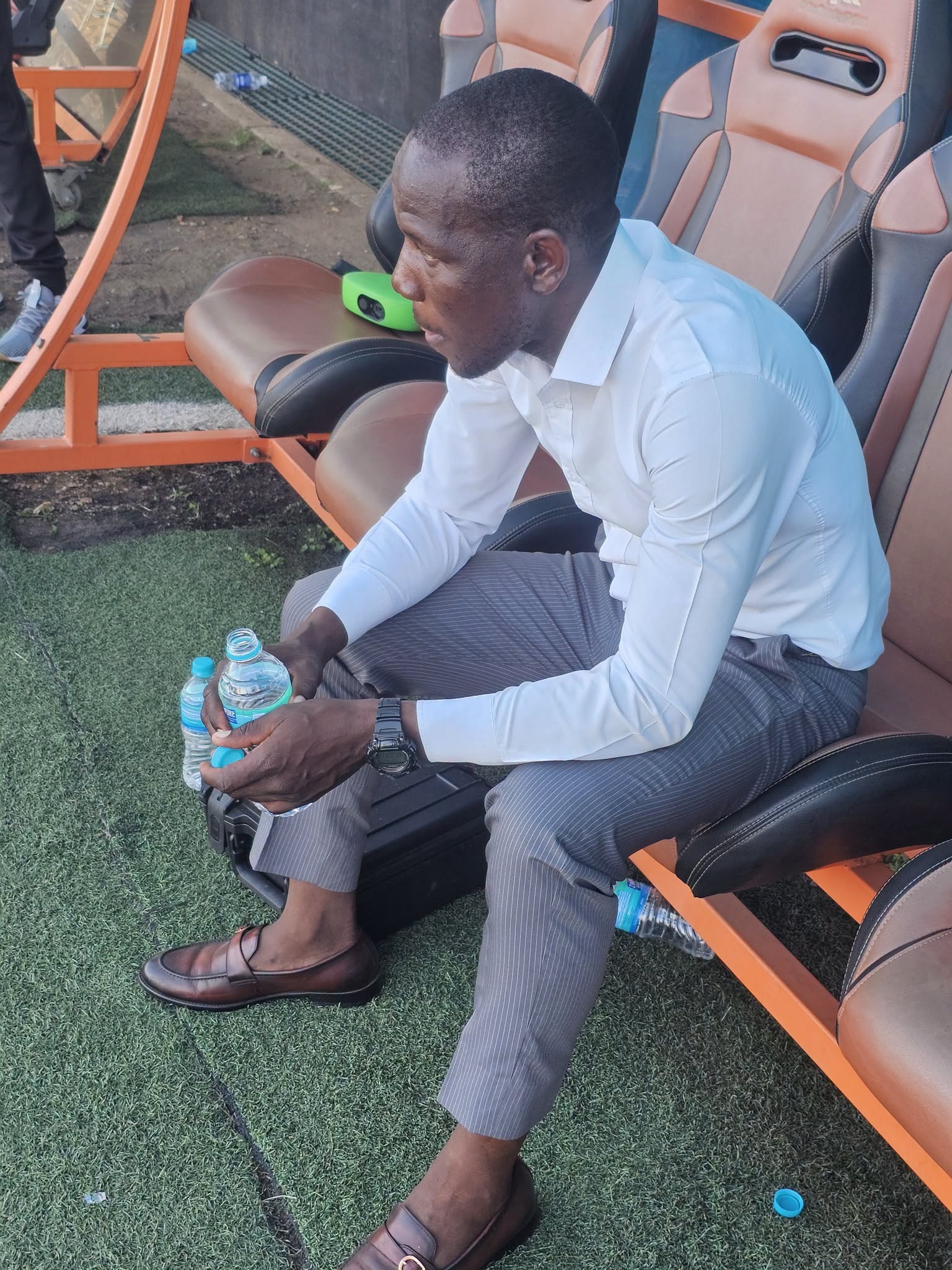
A season ago, CAPS United were stuck in uncomfortable company. Alongside traditional giants Dynamos FC and Highlanders FC, the Green Machine spent large parts of the campaign glancing nervously over their shoulders, flirting with the relegation zone rather than dictating the title race. Performances were inconsistent. Identity was blurred. Belief, at times, felt borrowed rather than owned.
This season feels like a different club.
Under Takesure Chiragwi, CAPS United are not just winning — they are convincing. There is shape to their play, intent in their movement, and clarity in their decisions. Sunday’s 1-0 victory over TelOne FC, settled by Takunda Benhura’s first-half strike, did more than deliver three points. It pushed them two clear at the top and reinforced something deeper: this is now a team that knows what it is.
And perhaps more importantly, who it trusts.
Because at the heart of this transformation is a decision that has stirred debate but delivered results — Chiragwi’s reliance on familiarity. Six starters against TelOne — Kudzai Chigwida, Richard Hachiro, Nyasha Gurende, MacDonald Makuwe, Talent Chamboko and Benhura — are players he previously worked with at Ngezi Platinum Stars. Add Brett Amidu, Wallace Magalane and Chawananga Kaonga, and nine of the XI were new signings. Only Ishmael Wadi and Brian Kadamanja remain from last season’s core.
To some, it looks like a takeover. To Chiragwi, it looks like alignment.
“The players that are playing are CAPS United players,” he said, pushing back against criticism. It was less a defence and more a statement of principle.
Because in truth, this is not new. It is one of football’s oldest, quietest truths — coaches don’t just build teams, they rebuild trust.
Across eras, leagues and philosophies, elite managers have always carried pieces of their past into their next project. Not out of sentiment, but out of certainty. Systems don’t travel alone. People do.
Look at Pep Guardiola. His football is often framed as ideology, but in practice it has always been anchored by interpreters — players who understand not just what he wants, but why he wants it. At Barcelona, that meant the La Masia spine — Xavi, Iniesta, Busquets — the internal language of his game already fluent. At Bayern Munich, he moved for Thiago Alcântara, a player who could translate that language instantly. At Manchester City, the pattern continued: Ilkay Gündogan, Bernardo Silva, João Cancelo — tactically intelligent footballers who could operate within the rhythm of his positional play. Guardiola does not just sign ability. He signs understanding.
Mikel Arteta, shaped in that same school, has applied a similar logic at Arsenal. His rebuild has not been a scatter of talent but a curation of profiles. Oleksandr Zinchenko and Gabriel Jesus arrived from Manchester City carrying not just quality but memory — of spacing, of timing, of structure.
With Antonio Conte, the idea sharpens. His systems are non-negotiable, and so his trust becomes even more valuable. At Juventus, it was the BBC defence — Barzagli, Bonucci, Chiellini — a unit that embodied his rigidity. At Chelsea, Victor Moses was reprogrammed into a wing-back, N’Golo Kanté became the engine of transition. At Inter, he had Romelu Lukaku when he won the title, not just as a striker, but as a solution he already understood. Lukaku joined Conte at Napoli for a second stint under the Italian manager.
Then there is Jose Mourinho, football’s great pragmatist and perhaps its most loyal collector of players. From Porto to Chelsea, Inter to Madrid, Manchester United to Roma, Mourinho has repeatedly leaned on those he trusts in moments rather than systems. Ricardo Carvalho followed him. Nemanja Matić moved under him from Chelsea to United. Diego Milito became his decisive edge at Inter. Even Zlatan Ibrahimović, across different chapters, represented Mourinho’s preference for players who require fewer explanations and deliver more certainty.
And in the modern coaching wave, Enzo Maresca represents continuity as strategy. A disciple of Guardiola, his approach — like many of his generation — is built on importing familiarity as much as installing ideas. Coaches no longer arrive alone. They arrive with references.
Zoom out, and the pattern is everywhere. Carlo Ancelotti working repeatedly with players like James Rodríguez. Rafael Benítez building around trusted cores. Sir Alex Ferguson constantly reshaping Manchester United, but always around players he trusted to carry the culture forward.
Because here is the underlying truth: a coach does not just sign players. He signs certainty.
Which brings the conversation back to CAPS United.
When Chiragwi leans on players he worked with at Ngezi, he is not importing the past — he is accelerating the present. Trust shortens the learning curve. Familiarity sharpens execution. Systems demand understanding, and understanding often comes pre-built.
The criticism, then, raises an interesting question: when a player moves, does his identity follow his past or adapt to his present?
Is Benhura still a Ngezi player in CAPS colours? Or is he now fully CAPS United?
Because history is clear. Once the badge changes, so must the lens. Judging players by where they come from rather than what they deliver risks missing the point entirely.
What has changed at CAPS United is not just personnel, but direction. Last season’s group struggled to impose itself. This season’s version, reshaped and re-energised, is executing a defined idea. Football is brutally simple in its evaluation — results. And right now, the results favour Chiragwi.
Coaches are replaced and players are moved on for one reason: something has to improve.
CAPS United made that call. Early evidence suggests they were right.
Which leaves one final, uncomfortable question for the stands. Would supporters prefer the familiarity of last season’s struggles just to recognise names on a team sheet? Or are they, perhaps inadvertently, questioning the ambition — and investment — of owner Farai Jere to return this club to its expected place?
Eight games in, the answers are not complete. The league is long. Cup football will stretch the squad. Tests will come.
But for now, CAPS United are no longer surviving.
They are setting the pace.