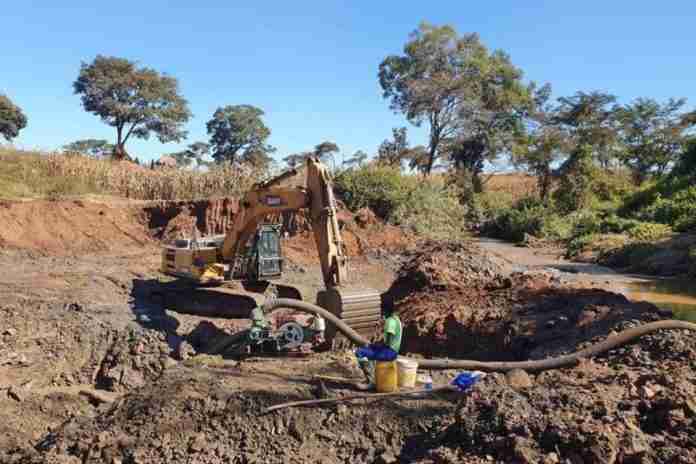
Zimbabwe has declared a nationwide state of disaster over the destruction of river ecosystems caused by years of alluvial gold mining, marking one of the government’s strongest environmental interventions in recent years as authorities move to restore waterways critical to agriculture, urban water supplies and industry.
The emergency declaration, gazetted under Statutory Instrument 91 of 2026 on Wednesday, establishes a sweeping state-led rehabilitation programme targeting rivers damaged by both legal and illegal riverbed mining activities.
The move comes as officials warn that unchecked alluvial mining has begun threatening irrigation systems, dam capacity, urban water supplies and long-term food security in parts of the country already vulnerable to climate shocks and recurring droughts.
“I am humbled by the President’s bold magnanimity to eliminate this scourge of degradation of rivers from alluvial mining activities to allow ecosystem restoration for agriculture, industry and the environment,” Agriculture Minister Anxious Masuka said.
“For example, areas proximal to Mazowe and Mwenje dams have had to reduce the area under irrigation for winter wheat due to alluvial mining activities and diversion of river systems. In Umzingwane, alluvial mining activities threatened supply of water to Bulawayo, while the Mutare river is choked and diverted thus interrupting water flow.”
The statutory instrument identifies some of Zimbabwe’s most economically significant river systems — including the Mazowe, Save, Sanyati, Mupfure, Umzingwane and Mutare rivers — as priority rehabilitation zones.
Government officials say large-scale mechanised alluvial mining operations that intensified after 2011 left many rivers heavily silted, polluted and ecologically destabilised, with river channels diverted and aquatic ecosystems severely damaged.
Under the new framework, the government has established an Inter-Ministerial Committee on Riverine Ecosystems Rehabilitation bringing together ministries responsible for environment, mining, water, local government and home affairs.
The programme will oversee rehabilitation contracts, environmental monitoring and enforcement through the Environmental Management Agency, ZINWA, provincial authorities and security agencies.
The rehabilitation strategy includes removal of invasive species and mining debris, restoration of river channels, stabilisation of riverbanks, revegetation using indigenous species, sediment control and continuous water quality monitoring.
In a controversial provision likely to attract close scrutiny from environmental groups and mining operators, approved rehabilitation contractors will be allowed to recover minerals encountered during restoration work under strict regulatory supervision.
Authorities insist the provision is designed to help finance costly rehabilitation works rather than reopen riverbed mining through the back door.
The law explicitly states that rehabilitation programmes cannot be used as a cover for ordinary alluvial mining operations and empowers authorities to halt any contractor deemed to be causing further environmental damage.
Zimbabwe’s intervention reflects growing pressure across resource-dependent African economies to balance mineral exploitation with environmental sustainability as climate risks intensify.
The country’s rivers are increasingly becoming strategic national assets not only for mining, but for irrigation, hydro-infrastructure, urban water supplies and industrial production.
For Zimbabwe, the broader concern appears increasingly urgent: degraded rivers now threaten agriculture, food security, urban water systems and long-term climate resilience at a time when Zimbabwe is already battling more frequent drought cycles and rising pressure on water resources.
📲 Join more than 10000 others who get news updates from Yafm Zimbabwe – https://whatsapp.com/channel/0029VaDPqsZ5fM5TIAxYww1U