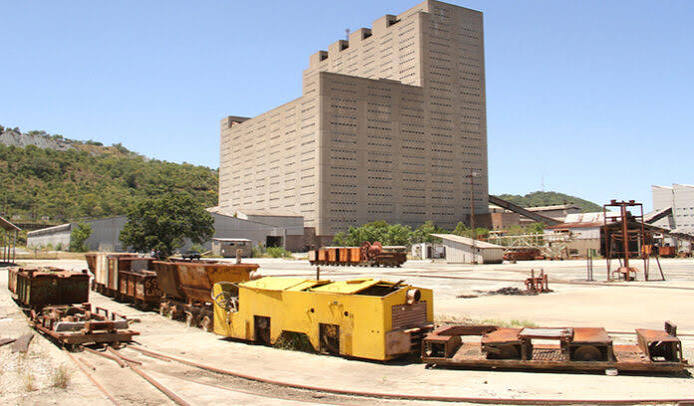
The closure of one of Zimbabwe’s most important mining companies was not merely the consequence of weak commodity prices or corporate mismanagement, according to Buy Zimbabwe Chairman Munyaradzi Hwengwere. It was also the outcome of a regional trade battle that Zimbabwe lost.
Writing against the backdrop of South Africa’s latest anti-immigration protests, Hwengwere argues that Zimbabwe has misunderstood the economics of regional trade for decades. While South Africa has consistently protected strategic industries through tariffs, regulation and non-tariff barriers, Zimbabwe has often embraced imports with comparatively little resistance—even when local industry was capable of supplying the same products.
For Hwengwere, no example better illustrates that imbalance than the fate of Shabanie Mashava Mines (SMM).
At its peak, SMM was among Africa’s largest producers of chrysotile asbestos, employing more than 5,000 workers directly while sustaining tens of thousands of livelihoods across Zvishavane, Mashava and the Midlands province. The mines anchored entire local economies, supporting transport operators, retailers, schools, housing developments and municipal revenues.
The industry’s decline, Hwengwere argues, accelerated after Zimbabwe’s asbestos products became commercially competitive internationally.
“That decision, in many ways, led to the closure of Shabanie Mashava Mines and the loss of over 5,000 direct jobs. Were it not for Mimosa Mining Company, whose production picked up at the right moment, the booming Zvishavane of today would long have been reduced to a ghost town. Official estimates are that over 20,000 people were thrown into poverty by that South African decision.”
The decision he refers to was South Africa’s prohibition of Zimbabwean asbestos products after local manufacturer Turnall had emerged as a leading supplier of World Health Organisation-approved chrysotile asbestos roofing sheets. Zimbabwe’s chrysotile differs from the blue and brown amphibole asbestos varieties that were widely banned internationally because of their significantly higher health risks. Although chrysotile has also become heavily restricted in many jurisdictions, Zimbabwe maintained that its products met international safety standards when properly handled.
According to Hwengwere, South African manufacturer Everite, then part of construction group Group Five, promoted alternative fibre-cement products but struggled to compete against Zimbabwean sheets. The ensuing lobbying campaign ultimately resulted in restrictions that effectively closed South Africa—Zimbabwe’s largest regional export market—to local asbestos products.
Whether viewed primarily through commercial competition or public health policy, the economic consequences inside Zimbabwe proved severe.
When SMM entered prolonged reconstruction, Zvishavane and Mashava experienced one of the country’s most dramatic mining contractions. Thousands lost formal employment while surrounding businesses collapsed as disposable incomes disappeared almost overnight. Property values fell, municipal revenues weakened and local supply chains unravelled.
The episode continues to resonate today. Only this week Zimbabwe’s Constitutional Court upheld a ruling allowing former Shabanie workers to continue pursuing unpaid terminal benefits dating back almost fifteen years, underscoring how deeply the mine’s collapse continues to affect former employees and their families.
For Hwengwere, the broader lesson extends well beyond asbestos.
He argues that South Africa has consistently demonstrated a willingness to defend domestic production whenever local employment is threatened. Shortly after democratic transition in the 1990s, Pretoria imposed a 64 percent tariff on Zimbabwean textile imports, a move widely viewed as protecting South Africa’s own clothing manufacturers from Bulawayo’s once-powerful textile industry.
More recently, South African steel producers have reportedly lobbied against Zimbabwe’s emerging Manhize Steel Plant, while Pretoria has criticised Zimbabwe’s Statutory Instrument 87 of 2025, which restricts grain imports in order to protect local farmers.
To Hwengwere, these developments reflect a coherent industrial strategy rather than isolated policy decisions.
Meanwhile, Zimbabwe continues to run one of its largest bilateral trade deficits with South Africa. According to the Zimbabwe National Statistics Agency (ZIMSTAT) and the Reserve Bank of Zimbabwe, South Africa consistently accounts for roughly 35 to 40 percent of Zimbabwe’s total imports, supplying everything from processed foods and agricultural products to machinery, chemicals, construction materials and consumer goods.
Mining illustrates the imbalance particularly clearly.
Zimbabwe’s mining sector generates more than US$5 billion annually in export earnings, yet industry estimates suggest mining companies still import a significant share of equipment, consumables and industrial inputs that could potentially be manufactured domestically. Hwengwere estimates locally produced goods account for less than 15 percent of procurement across parts of the sector.
His argument arrives as thousands of Zimbabweans continue returning from South Africa following rising anti-immigration tensions. According to South Africa’s 2022 Census, approximately 1.16 million Zimbabweans now live there, representing nearly half of all foreign nationals recorded in the country. Much of that migration has been driven by employment opportunities unavailable at home.
Rather than viewing the current tensions primarily through the lens of migration, Hwengwere believes Zimbabwe should see them as evidence of a deeper production problem.
Countries that protect strategic industries ultimately protect employment, he argues. Countries that depend heavily on imports inevitably export jobs alongside consumer spending.
“The best response,” he suggests, “is not anger over xenophobia, but rebuilding domestic productive capacity.”
For Zimbabwe, that means strengthening value addition, enforcing local procurement policies, supporting manufacturing and ensuring that the country’s mineral wealth creates industrial ecosystems rather than simply shipping raw materials abroad.
The collapse of Shabanie Mashava Mines remains one of Zimbabwe’s most enduring industrial scars.
For Hwengwere, it is also a reminder that in international trade, governments rarely apologise for protecting domestic jobs. The real question, he argues, is whether Zimbabwe is prepared to protect its own with the same determination.
Read Munyaradzi Hwengwere`s full article here – South Africa’s rising Xenophobia a big opportunity for Zimbabwe – GreatDykeNews24