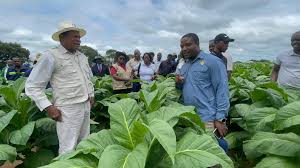
In a historic triumph for Zimbabwe’s agricultural sector, the nation has set a new national record for flue-cured tobacco production, with sales reaching an unprecedented 299,158,624 kilograms as of June 17, 2025. This milestone, announced by Minister of Lands, Agriculture, Fisheries, Water and Rural Development, Hon. Dr. Anxious Jongwe Masuka, surpasses the previous record of 296 million kilograms set in the 2022/2023 season, marking a defining moment in Zimbabwe’s journey toward Vision 2030.
“This stellar collective achievement is a testament to the resilience of our farmers, the dedication of merchants, and the support of enablers,” Minister Masuka declared, saluting stakeholders for their role in driving the industry forward. With sales still ongoing, Zimbabwe is poised to breach the coveted 300-million-kilogram mark, a target set under the government’s ambitious Tobacco Value Chain Transformation Plan.
Zimbabwe’s tobacco industry has undergone a profound transformation since the land reforms of the early 2000s, which saw the collapse of large-scale commercial farming. In 1999, approximately 2,000 predominantly white commercial farmers produced a peak of 236 million kilograms. Fast forward to 2025, and over 100,000 smallholder black farmers have not only reclaimed but redefined the industry, producing a record-breaking 299 million kilograms.
Historical data underscores this remarkable recovery:
• 1998: 260 million kg (pre-land reform peak).
• 2015: 166 million kg (post-reform low).
• 2018: 258 million kg (post-land reform record).
• 2023: 296 million kg (previous all-time high).
• 2025: 299 million kg and counting.
The resurgence is attributed to the introduction of the contract farming system in 2005, which saw companies like British American Tobacco and China’s Tian Ze Tobacco provide inputs, technical support, and guaranteed markets. By 2016, 80% of Zimbabwe’s tobacco was grown under contract, with Tian Ze issuing $40 million annually in interest-free loans. Decentralized contract sales and operational auction floors have further empowered smallholder farmers, who now account for 75% of production.
Despite challenges like the El Niño-induced drought in 2024, which reduced output to 265 million kilograms, the 2025 season has seen a rebound fueled by favorable rains and increased farmer participation, with 148,527 registered growers cultivating 117,000 hectares.
Zimbabwe’s Global Standing
Zimbabwe is Africa’s largest tobacco producer. In 2023, global tobacco production stood at 6.4 million metric tons, with Zimbabwe contributing 296 million kilograms, or roughly 4.6% of the total. The country’s flue-cured Virginia tobacco, renowned for its flavor, commands premium prices, with the 2025 season opening at $4.92 per kilogram, up from $4.35 in 2024.
In 2023, Zimbabwe exported 234 million kilograms, generating nearly $1 billion in foreign currency, accounting for over 12% of national exports. China, purchasing 54% of Zimbabwe’s tobacco in 2015, remains the primary market, alongside emerging opportunities in Europe and Asia. The government’s push for value addition—aiming to increase processing from 2% to over 30%—could see the industry’s value soar to $60 billion by 2028, aligning with global projections of a $1 trillion tobacco market.
Vision 2030 and Agricultural Innovation
This milestone is a cornerstone of Zimbabwe’s Vision 2030, which seeks to transform the nation into an upper-middle-income economy. The Tobacco Value Chain Transformation Plan, launched in 2021, targets 300 million kilograms by 2025 while promoting local processing to curb raw leaf exports. Minister Masuka emphasized, “We seek to localize the financing of tobacco and transform the sector so we don’t export value.”
Innovations like drought-resistant tobacco varieties and irrigation expansion—aiming for 350,000 hectares by 2025—have bolstered resilience against climate change. The Tobacco Industry and Marketing Board (TIMB) supports sustainable practices, including eucalyptus plantations to reduce deforestation from tobacco curing, which accounts for 20% of Zimbabwe’s annual forest loss.
Youth and women are increasingly central to the industry, with 43% of farmers being youth and 28% women in 2023, reflecting a seven percent rise in youth participation since 2022. As Minister Masuka noted, “Tobacco farmers have become upper-middle-income earners,” highlighting the crop’s role in poverty alleviation.
As Zimbabwe nears the 300-million-kilogram milestone, the achievement resonates beyond agriculture, symbolizing national resilience and unity. “Together, we can do so much more,” Minister Masuka concluded, echoing President Mnangagwa’s vision of collective progress. Zimbabwe’s tobacco story is one of reinvention and ambition. As the nation celebrates this record, it stands poised to redefine its place in the global agricultural landscape, proving that from seed to success, Zimbabwe’s farmers are sowing a legacy for generations to come