By Moses Charedzera
Recent estimates put China second to the US in terms of nominal GDP at around US$20 trillion compared to US$30 trillion for America. In terms of Purchasing Power Parity (which adjusts for cost of living and local prices), China leads the US as the world’s largest economy at US$40 trillion, with America coming second at a GDP PPP of US$30 trillion.
This has indeed been a remarkable achievement for a country that was considered poor in the late 1970s. Over the course of a few decades, China has leapfrogged economic powerhouses such as Japan and Germany to earn its place at the apex of global economic power.
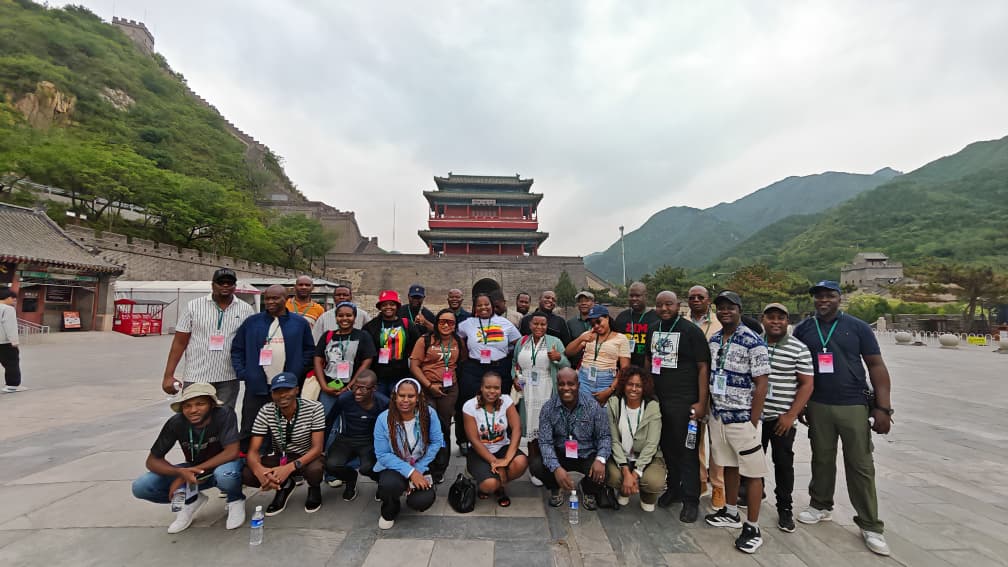
It was with much excitement that a 29-member team of media professionals from Zimbabwe recently embarked on a tour to attend a two-week seminar in China. Some had been to the country before, while many were visiting for the first time. Combining lectures and on-site visits, the seminar proved to be an eye-opener on how China has modernised its economy.
After the death of Chairman Mao Zedong in 1976, Deng Xiaoping took over as China’s paramount leader and launched reforms towards a socialist market-driven economy, according to Ambassador Sun Jiwen. This involved opening up China’s economy to the world and establishing special economic zones that promoted rapid industrialisation.
From a relatively poor country, China has now managed to lift a significantly larger part of its 1.4 billion population out of absolute poverty. We were told that only about 20 million people are still living in absolute poverty. This is a remarkable achievement recorded over the years under President Xi Jinping.
This year marks the beginning of China’s 15th Five-Year Development Plan. The results of successive years of strategic planning and implementation were clearly visible.
Our group marvelled at the towering skyscrapers and countless interchanges. In the capital, Beijing, the transport system is a multi-modal mix of automobiles, trams, subway trains, bicycles and scooters. One of the exciting innovations is the use of bicycles on a ride-and-park basis. Anyone needing a bike simply walks to the street, scans a QR code on a parked bicycle and takes a ride. Upon reaching one’s destination, the bike is parked for the next rider.
In commerce, payment systems have become largely digital. In Chongqing, a colleague and I ordered a two-piece chicken and chips combo only to be told that our preferred choice could only be paid for through an app. A pleasant 10-year-old boy, who turned out to be our translator, then proceeded to pay for his order using his smartwatch.
Technology and innovation have taken off in a big way in China. During our stay, we visited the Communist Party of China Museum, the Hubei JCHX Mining Services Corporation Headquarters, the Chongqing International Logistics Hub Exhibition and the Beijing 718 Arts and Culture District. At all these visits, we were treated to enthralling and unforgettable virtual reality experiences. At the CPC Museum, the experience was complete with water droplets sprayed on us when the boat we were virtually riding hit the water.
In Chongqing, a massive city of 32 million people, one of our colleagues was stunned when he ordered bath soap from the hotel reception and it was promptly delivered to his room on the eighth floor by a robot. I personally encountered the robot while getting into the lift as it was leaving. It was amazing to see it navigating independently.
The Beijing Library was another spectacle of technology, with its advanced biometric systems. Forget library cards and date stamps. Using on-shelf cameras and shelf sensors, the system automatically recognises and records anyone who removes a book from the shelf and takes it home for reading.
China has also made tremendous progress in electric vehicles. On my first visit to China in 2008, Beijing’s air was heavily polluted with vehicle fumes and smog. That polluted air is now largely gone. Colleagues remarked on the massive drive to plant trees across all unbuilt areas to create carbon sinks and green belts around the city. More telling, however, has been the introduction of EVs on the roads. China is now the leading producer of EV battery technology and electric vehicles globally. A significant proportion of vehicles on the country’s roads are EVs. Brands such as BYD, Geely and NIO are steadily increasing their market share and global presence.
Through deliberate effort, China has developed key economic zones into manufacturing and logistics hubs such as Chongqing under the Belt and Road Initiative. The city is now a major rail, shipping, road and air logistics centre connecting Asia, Europe and parts of Africa.
Asked how Zimbabwe could follow China’s developmental route, one of the lecturers said each country must discover what works best for it. We were reminded of the words of revolutionary thinker Frantz Fanon: “Each nation must, out of relative obscurity, discover its mission, fulfil it, or betray it.”
The big question on the minds of participants was whether Zimbabwe could emulate the Chinese example and whether it was indeed possible. Many agreed that it was possible, but would require deep introspection and commitment, while others pointed to the need for strong leadership and decisive action against corruption.